
Chicago Tanker Truck Accident Attorney
Tankers carry fuel, chemicals, and liquefied gas across Chicago’s expressways every day. Their high center of gravity makes rollovers routine, and the cargo itself turns a crash into a fire, a toxic plume, or both. We investigate every layer — driver, carrier, hazmat compliance, and shipper.
Available 24/7 · No fee unless we win · Licensed in Illinois
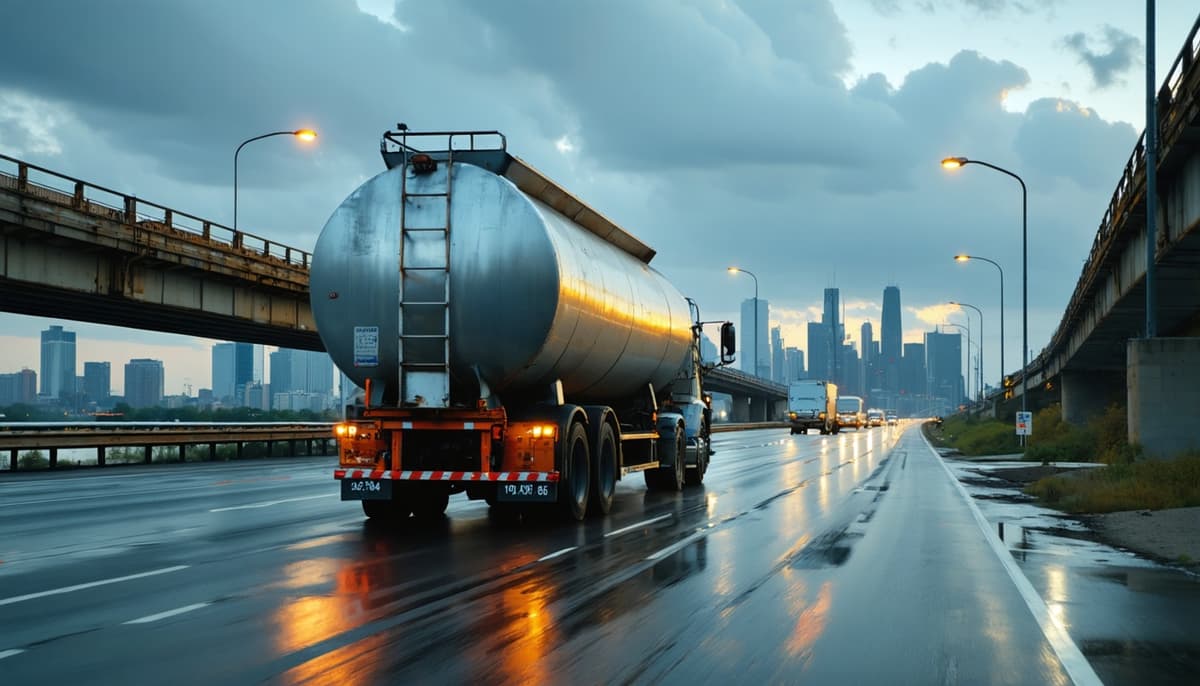
What makes a tanker truck accident different?
Tanker crashes combine the force of an 80,000-pound commercial vehicle with the risk of a fuel fire, chemical plume, or explosion. Federal hazmat regulations (49 CFR Parts 171–180) and MCS-82 insurance endorsements create liability and coverage questions that do not exist in a standard truck case. Chicago’s position as a national freight corridor makes tanker traffic — and tanker crashes — routine on the interstates and industrial belt.What federal hazmat regulations apply to tanker cases?
Tanker transporters carrying hazardous materials fall under 49 CFR Parts 171-180 (HMR — Hazardous Materials Regulations). Drivers must hold a Hazmat endorsement (H) on their CDL, undergo background checks under 49 CFR § 1572, carry specific shipping papers, and follow routing restrictions. Violations — even minor ones — routinely establish negligence per se and invite punitive damages when a crash produces injury.How does MCS-82 insurance endorsement expand coverage?
The MCS-82 endorsement required under 49 CFR § 387.9 for bulk-hazmat carriers raises the federal minimum to $5,000,000 — vs. $750,000 for general freight. That minimum is a floor, not a ceiling: most serious tanker carriers stack primary and excess layers reaching $10M-$50M. Identifying every MCS-82 filer in a multi-party tanker crash is a core part of the opening-investigation checklist.Why do tanker rollovers produce such severe outcomes?
Tanker geometry puts the load high. When a tanker begins to tip on a curve or off- ramp, the liquid cargo shifts instantly and amplifies the roll — often beyond recoverable. Post-rollover, ruptured tanks release fuel, chemicals, or compressed gas into the crash scene, producing fires, burn injuries, chemical exposure, and secondary collisions with pursuing traffic. Burn-unit-level injuries dominate the damages picture.Why Tanker Crashes Are Different
A tanker truck is never just a truck. The cargo itself — liquid fuel, anhydrous ammonia, chlorine, liquefied natural gas, or milk — changes the physics of every maneuver. A partially filled smooth-bore tanker can slosh hundreds of gallons of liquid in a single turn, shifting the truck’s center of gravity and causing rollovers even at modest speeds. Baffled tankers reduce but do not eliminate slosh dynamics.
When the cargo is flammable or toxic, a rollover or collision becomes a fire, an explosion, or a plume of toxic gas. Burn injuries, inhalation injuries, chemical burns, and PTSD from witnessing the event all become part of a single case.
Common Causes of Illinois Tanker Truck Accidents
- Rollover during turns or ramp transitions — especially on the tight cloverleaf exits at I-290/I-88, I-80/I-94, and the Chicago Skyway.
- Improperly secured valves and hatches — leaks that create fuel trails, chemical vapor, or cargo loss in motion.
- Slosh-induced loss of control — partially filled smooth-bore tankers behaving unpredictably under braking.
- Driver fatigue — fuel hauls often run overnight to reduce traffic exposure.
- Brake failure under the heat and weight of a loaded tanker.
- Hazmat placarding and paperwork violations — incorrect or missing placards can delay first responder action and worsen exposure injuries.
- Inadequate driver endorsements — CDL holders who lack the required tanker (N) or hazmat (H/X) endorsements.
Hazmat Regulations and Liability Exposure
Tanker operations live under a parallel federal regulatory scheme. The Hazardous Materials Regulations (49 CFR Parts 171–180) govern packaging, marking, labeling, placarding, route restrictions, and driver qualifications. The carrier must hold an MCS-90 insurance endorsement in every case and, for certain materials, an MCS-82 endorsement with coverage up to $5 million. Violations of these regulations are admissible as negligence per se in most Illinois cases.
The shipper — the company that loaded the cargo — is often a defendant under the shipper-loader doctrine and under federal hazmat training regulations. The tanker manufacturer and component manufacturers (valves, baffles, rollover protection) can be co-defendants where equipment failure contributed.
Burn, Chemical, and Crush Injuries
Tanker crashes produce a distinctive pattern of injuries: second- and third-degree thermal burns from fuel fires, chemical burns from corrosive cargo, inhalation injuries from toxic fumes, traumatic brain injuries from rollover impact, and orthopedic injuries from crush forces. Treatment often requires specialty burn-unit care (Loyola, Northwestern, University of Chicago) with long rehabilitation. Fatal tanker fires trigger Illinois wrongful death claims under the Survival Act and Wrongful Death Act. We coordinate life-care planning experts and vocational experts to document the full economic consequences of injuries that frequently extend for decades.
Insurance Coverage Specific to Tankers
A typical hazmat tanker operation carries multiple layers of coverage: a commercial auto policy ($1M–$5M primary), excess and umbrella layers ($5M–$50M+), an MCS-90 endorsement covering public liability, an MCS-82 hazmat endorsement for certain materials, and a separate pollution policy for environmental cleanup. Our job is to identify every policy, every endorsement, and every additional insured — including the shipper and any downstream distributor — before the case becomes a settlement conversation.
How a hazmat tanker case is insured.
Tanker operations carry multiple layers of coverage simultaneously. A serious crash with catastrophic injuries will usually trigger more than one — which is why identifying every policy and every endorsement is the first step in a full-value recovery.
Coverage amounts are illustrative industry ranges. Actual policy limits vary by carrier, commodity, and operating authority.
How We Build Your Case
We act fast and investigate broadly. Within 48 hours we send spoliation letters, subpoena the carrier’s FMCSA/SAFER inspection history, pull the hazmat shipping papers (the "Dangerous Goods Declaration"), and coordinate with accident reconstructionists who specialize in tanker dynamics. When burn or inhalation injuries are involved, we retain medical experts in burn rehabilitation and toxicology from day one — the defense will be working just as hard.
All work is on contingency. You pay nothing unless we recover for you.
Frequently Asked Questions
Questions we hear most often from clients injured in tanker and hazmat truck crashes across Chicago and Illinois.
Tankers carry liquids — fuel, chemicals, milk, liquefied gas — with a high and shifting center of gravity. Even routine turns can trigger rollovers, and the cargo itself is often flammable, corrosive, or toxic. A single crash can produce crush injuries, burn injuries, and chemical exposure injuries in the same incident.
The Hazardous Materials Regulations (49 CFR Parts 171–180) govern packaging, placarding, driver qualifications, and route restrictions. Drivers must hold a CDL with both a tanker endorsement (N) and a hazmat endorsement (H or X). Carriers must carry an MCS-90 endorsement and, for certain materials, an MCS-82 with coverage up to $5 million.
These are typically separate. Environmental cleanup is governed by CERCLA and Illinois EPA statutes and is the carrier’s responsibility (often tendered to a separate pollution policy). Your personal injury claim runs through the carrier’s commercial auto liability and its MCS-82 hazmat endorsement. The cleanup obligation does not reduce what is available for injury compensation.
Yes. Chemical exposure injuries from a tanker release — inhalation injuries, chemical burns, respiratory damage — are compensable under the same liability framework as a direct-impact crash. Documenting the exposure timeline, the chemical involved (from the tanker’s placards and shipping papers), and your medical care from day one is essential.
Fast. ECM data overwrites on an endless loop. Drivers’ pre-trip inspection reports may be discarded. The tanker itself may be repaired or taken out of service. We issue spoliation letters within 48 hours and often coordinate independent inspection of the vehicle, valves, baffles, and load-securement equipment before the carrier can alter evidence.
Keep exploring the library.
Get your free case evaluation today
Were you or a loved one injured in a crash involving a commercial truck in the Chicago area? Get a free, confidential case evaluation.

Find Us
Chicago Truck Accident Lawyers1132 S Wabash Ave, Suite 303
Chicago, IL 60605-2305
Call 24/7312.728.2989
Get Directions