
Chicago Truck Accident Spinal Cord Injury Attorney
Spinal cord injuries produce the highest lifetime costs of any personal-injury outcome. Paraplegia, quadriplegia, and cervical fusion cases require neurosurgical consultation, physiatry, rehabilitation specialists, and a life-care planner working in coordination from the first month forward. We build those teams the week we are retained.
Available 24/7 · No fee unless we win · Licensed in Illinois
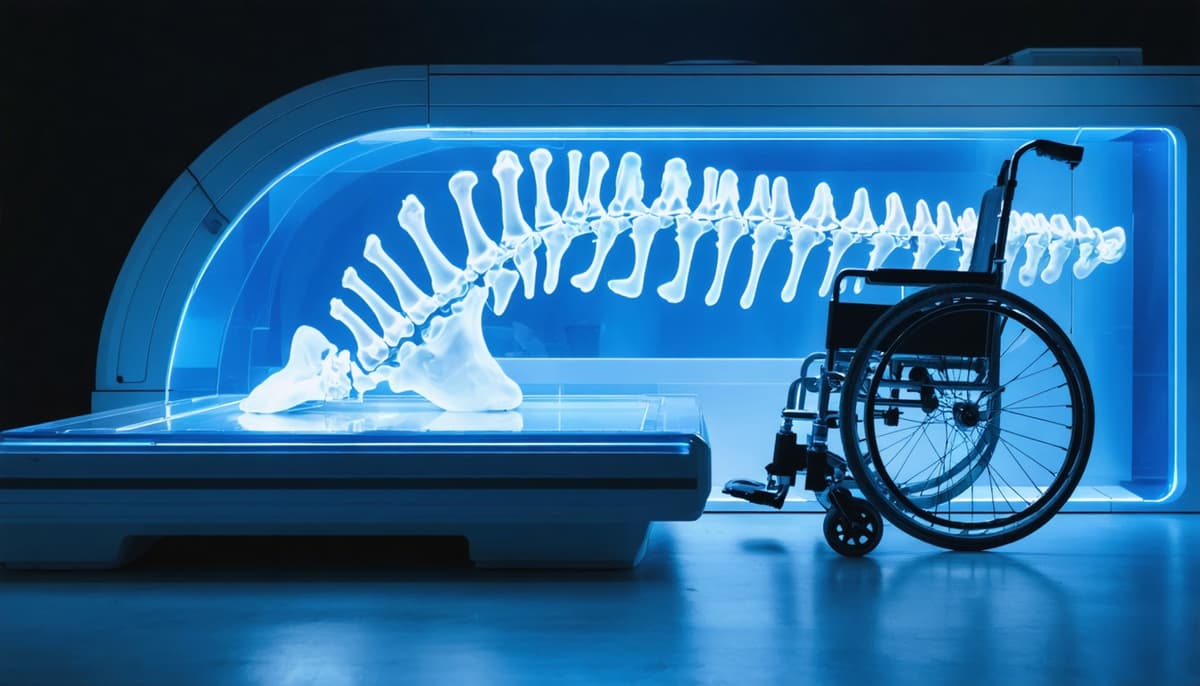
Why do truck accidents cause such severe spinal cord injuries?
Commercial truck crashes concentrate enormous force on the occupant compartment of the passenger vehicle — 80,000-pound semi-trucks weigh roughly 20× what a car weighs. Sudden deceleration, intrusion, and crushing impacts produce vertebral fractures, ligamentous disruption, and direct spinal cord trauma at rates far above those of ordinary car accidents. The ASIA impairment scale — complete (A) through normal (E) — determines the clinical picture; the level of injury (cervical, thoracic, lumbar) determines lifelong functional capacity. Both are central to case value.What is the ASIA impairment scale?
The American Spinal Injury Association impairment scale grades spinal cord injury from A (complete — no motor or sensory function below the injury level) to E (normal). Grades B, C, and D represent incomplete injuries with varying degrees of preserved function. Combined with the anatomical level (C1-C8 cervical, T1-T12 thoracic, L1-L5 lumbar), the ASIA grade defines functional capacity, rehab potential, and lifetime care cost.How long does spinal cord recovery take?
Acute care typically runs 2-4 weeks depending on severity and surgical intervention. Rehabilitation extends 3-6 months for incomplete injuries and 9-18 months for complete injuries requiring adaptive-skills retraining. Maximum medical improvement (MMI) — the plateau at which further recovery is unlikely — is usually reached between 12 and 24 months post-injury. Settlements should not be negotiated before MMI is documented.What's the difference between cervical and lumbar spinal cord injuries?
Cervical injuries (C1-C8) affect upper limbs, respiratory function, and bowel/bladder control. Complete high-cervical injuries (C1-C4) require ventilator dependence and 24-hour care — the highest-cost injury category in civil cases. Lumbar injuries (L1-L5) primarily affect lower-extremity function and typically preserve trunk control, respiratory independence, and upper-limb function. Both require life-care planning.Injury Types & Level of Injury
Spinal cord injury severity is graded on the ASIA impairment scale (A–E) and categorized by level — the specific vertebra at which the cord is damaged. Level determines functional capacity more than any other clinical variable.
- C1–C4 (high cervical) — tetraplegia with ventilator dependence. Requires 24-hour skilled nursing and advanced attendant care.
- C5–C7 (mid-to-low cervical) — tetraplegia with preserved partial upper-limb function. Independent wheelchair mobility may be possible.
- T1–T6 (upper thoracic) — paraplegia with full arm/hand function. Independent wheelchair mobility; some may walk with extensive bracing.
- T7–L5 (lower thoracic and lumbar) — paraplegia with varying hip, knee, and foot involvement. Ambulation with bracing and crutches may be achievable for some patients.
- Incomplete injury — partial preservation of motor or sensory function below the level of injury. ASIA B–D impairment scales. Rehabilitation potential varies widely.
- Cervical and lumbar fusion — surgical stabilization after disc herniation or vertebral fracture. Often leaves permanent restriction of motion and chronic pain without paralysis.
Acute Care, Surgery, & Rehabilitation
Spinal cord injury care begins with emergency stabilization — immobilization at the scene, expedited imaging, and frequently emergent neurosurgical intervention. Stabilization surgery (fusion, hardware, decompression) is followed by inpatient rehabilitation, typically 8–16 weeks at a specialized SCI facility. Outpatient physical and occupational therapy continues for years.
Secondary complications — pressure injuries, autonomic dysreflexia, urinary complications, respiratory issues — are lifelong management concerns. The plaintiff’s life-care plan must account for these predictable events, not only the baseline care regimen.
Medical Experts a Case Requires
- Treating neurosurgeon — describes the surgical course, the injury’s structural basis, and prognosis.
- Physiatrist — physical medicine and rehabilitation specialist who manages the plaintiff’s rehabilitation trajectory.
- Rehabilitation nurse / life-care planner — translates clinical record into projected care needs over the plaintiff’s lifetime.
- Vocational economist — calculates lost earning capacity based on pre-crash trajectory and post-crash functional capacity.
- Psychological / psychiatric expert — documents depression, adjustment disorder, and the emotional dimensions of catastrophic injury.
- Accident reconstructionist — connects the crash mechanism to the specific forces that produced the injury.
Lifetime Costs & Life-Care Planning
Spinal cord injury produces the highest lifetime medical costs of any personal-injury diagnosis. The National Spinal Cord Injury Statistical Center’s data show first-year costs above $1.2M for high-cervical tetraplegia, and subsequent annual costs above $200,000. Complete paraplegia totals $2–3M lifetime in direct medical costs alone. These figures exclude lost earnings, attendant care above standard medical coverage, home modifications (ramps, roll-in showers, widened doorways, lifts), adaptive vehicles, and family economic burden — each of which a life-care planner develops as a dedicated line item in the case model.
Insurance Coverage & Case Value
Because of the lifetime-cost magnitude, spinal cord injury cases almost always exhaust primary coverage and push into stacked excess layers. The $750,000 federal minimum (49 CFR § 387.9) is rarely relevant except at the smallest owner-operator level; serious carriers carry $1M primary plus $5M–$25M in excess layers, and when multiple defendants are in the case, coverage can stack to $50M or more. Identifying and pressuring every available policy is central to the full-value recovery that catastrophically-injured plaintiffs need.
How We Build Spinal Cord Cases
From the first week, two coordinated investigations run in parallel: the liability investigation (spoliation, ECM/ELD preservation, carrier discovery, accident reconstruction, FMCSA SAFER pulls) and the medical/economic development (treating specialist coordination, life-care planning, vocational-economic projection, specialized imaging).
Spinal cord injury cases frequently arise from the crash dynamics of driver fatigue, defective brakes, and improper loading. If a commercial truck caused your or a loved one’s spinal cord injury, call Zayed Law Offices for a free consultation. We work on contingency — no fee unless we recover.
Frequently Asked Questions
Questions about spinal cord injury cases after a commercial truck crash in Chicago or Illinois.
The spectrum runs from cervical strain and herniated disc at the mild end, through cervical or lumbar fusion surgery, to incomplete spinal cord injury and complete paraplegia or quadriplegia at the severe end. Level of injury matters enormously — a C3 injury leaves the patient dependent on ventilator support, a C5 injury preserves some upper-limb function, a T6 injury permits full upper-body function but paraplegia from the chest down. Level determines care needs, earning capacity, and case value.
The National Spinal Cord Injury Statistical Center reports that first-year costs for high-cervical tetraplegia exceed $1.2 million, with subsequent annual costs above $200,000 — totaling well over $5 million over an average-age plaintiff’s lifetime. Lower-level paraplegia totals $2–3 million lifetime. These numbers reflect direct medical costs only; total economic loss including lost earnings, attendant care, and home modifications is substantially higher.
Diagnosis is imaging-anchored — CT for initial screening, MRI for spinal-cord and soft-tissue evaluation, and EMG/nerve-conduction studies for functional assessment. The American Spinal Injury Association (ASIA) impairment scale grades the injury from A (complete) to E (normal) and is the clinical standard. Treating neurosurgeons, physiatrists, and rehabilitation specialists document the trajectory. A life-care planner translates that record into projected needs.
Every defendant in the general liability chain applies: the driver, the motor carrier, the trailer owner, the shipper, the broker, and any maintenance contractor or component manufacturer whose negligence contributed. Serious spinal-cord cases routinely trigger multiple policies — the carrier’s primary $1M, stacked excess layers to $25M or higher, and independent policies for each additional defendant. Our opening investigation identifies every policy in the case.
Illinois’s two-year statute of limitations for personal injury applies (735 ILCS 5/13-202). Given the complexity of spinal cord cases — extended acute care, rehabilitation, and the need for life-care planning before settlement can be evaluated — starting the case early matters. We preserve evidence in the first 72 hours and develop the medical record alongside. The two-year limit does not wait for the plateau in functional recovery.
Keep exploring the library.
Get your free case evaluation today
Were you or a loved one injured in a crash involving a commercial truck in the Chicago area? Get a free, confidential case evaluation.

Find Us
Chicago Truck Accident Lawyers1132 S Wabash Ave, Suite 303
Chicago, IL 60605-2305
Call 24/7312.728.2989
Get Directions