
What to Do After a Truck Accident
The first 48 hours shape everything that follows. Here is a step-by-step checklist for what to do — and what not to do — after a truck crash in Chicago.
Available 24/7 · No fee unless we win · Licensed in Illinois
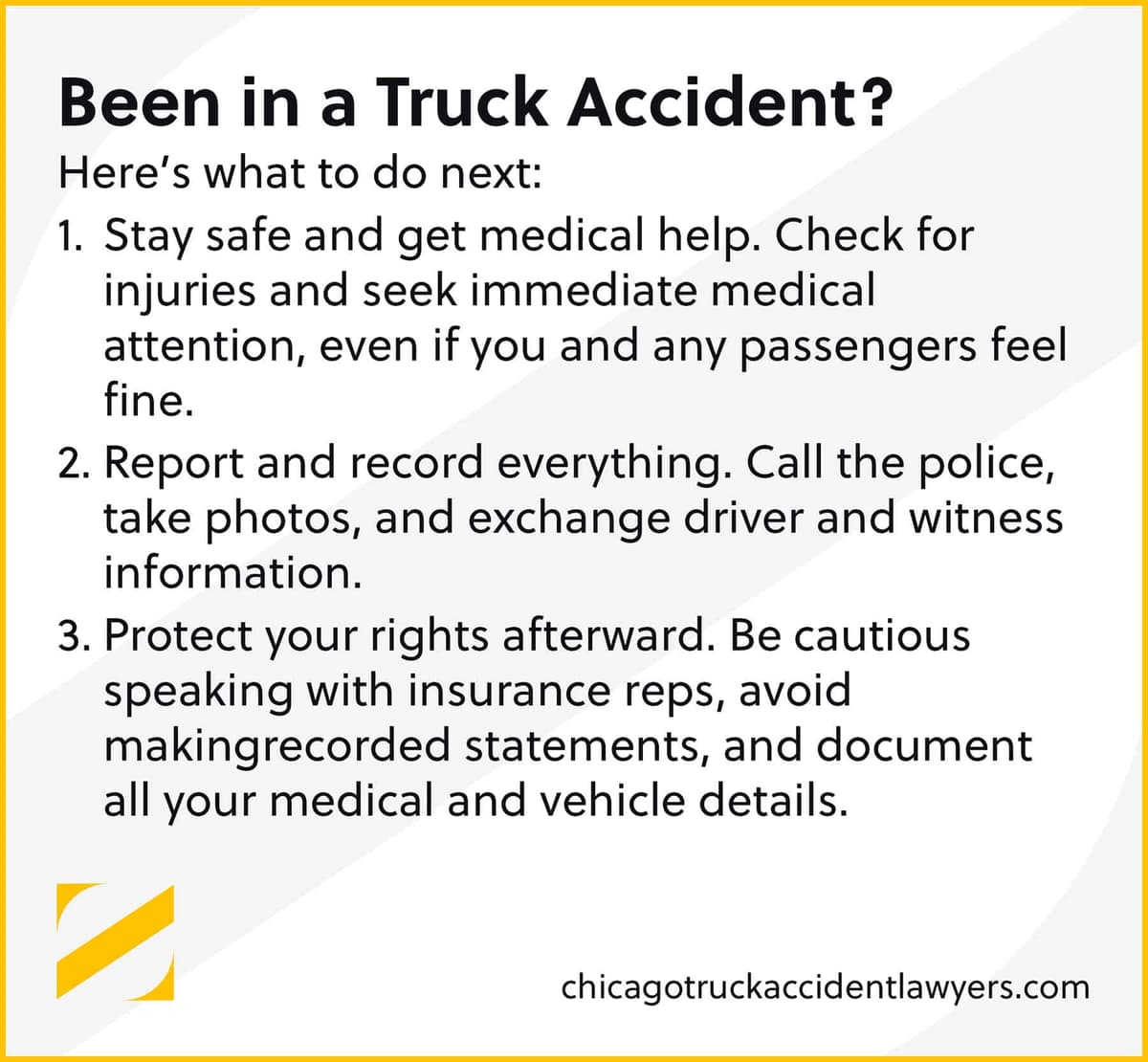
What should I do immediately after a truck accident in Chicago?
Call 911, get medical attention even if you feel uninjured, photograph the scene and all vehicles, collect contact and insurance information from everyone involved, write down what you can remember, report the crash to your own insurer, and speak with a Chicago truck accident lawyer before giving a recorded statement to the trucking company's insurance adjuster.What should I do in the first hour after a truck crash?
Check for injuries — yours and others. Call 911 and move to safety if possible. Request a Chicago Police or Illinois State Police report at the scene. Take photographs of every vehicle, license plate, DOT number (on truck cab doors), cargo condition, weather, road conditions, skid marks, and any visible injuries. Collect witness contact info. Don’t refuse the ambulance — documented emergency care matters legally and medically.What should I NOT do after a truck accident?
Don’t give a recorded statement to the trucking company’s insurer. Don’t sign a medical-release authorization broader than necessary. Don’t post details on social media. Don’t accept an early settlement offer before future medical care is quantified. Don’t discuss fault with anyone except police and your own counsel. Don’t throw away damaged personal property — it may be evidence.Do I need to call a lawyer immediately?
For any crash involving a serious injury or a commercial truck — yes, within days at most. ECM data overwrites within days to weeks, ELD records are only retained 6 months under 49 CFR § 395.8, and dashcam footage is frequently purged in 30 days or less. Spoliation letters have to go out immediately to preserve evidence. The earliest conversation with a lawyer is the most consequential one you’ll have.Step 1: Safety and 911
If you can move safely, get out of traffic. Call 911 — even if the crash seems minor. A police report is essential evidence, and dispatchers will send EMS, who should always evaluate anyone involved in a truck crash.
Step 2: Get Checked Out Medically
Go to the hospital, urgent care, or your primary care physician the same day or the next morning. Adrenaline can mask serious injuries — traumatic brain injury, whiplash, internal bleeding, and soft-tissue damage can all present hours or days later. Prompt evaluation also documents the link between the crash and your injuries.
Step 3: Document the Scene
- Photograph every vehicle from multiple angles
- Capture license plates, DOT numbers, and carrier names on the truck
- Photograph the road, signage, signals, skid marks, and debris
- Document your own injuries and vehicle damage
- If safe, take a photo of the truck driver's CDL and insurance card
- Record a short voice memo with what you remember while it's fresh
Step 4: Collect Information
- Name, phone, address, and license info for every driver involved
- Insurance company name and policy number for each driver and the carrier
- Names and phone numbers of every witness
- Police report number and responding officer's name
Step 5: Report the Crash to Your Own Insurer
Most auto policies require prompt notice of any accident. Report the crash to your carrier — but keep your statement factual and brief. Do not speculate about fault or the extent of your injuries.
Step 6: Don't Give a Recorded Statement to the Trucking Company
The trucking company's insurance adjuster will call, sometimes within hours. Politely decline to give a recorded statement, sign a medical authorization, or accept any early settlement — even a small one for vehicle damage. A lawyer handles all of that on your behalf so nothing you say is used to undermine your case.
Step 7: Call a Chicago Truck Accident Lawyer
Call us at the earliest opportunity — ideally within 24 to 72 hours of the crash. Trucking companies act fast; your lawyer needs to act faster. ECM data overwrites, ELD hours-of-service logs cycle within days, and dashcam footage is frequently purged in a month. See when to consult a lawyer for the timing mechanics. The consultation is free, and we work on contingency: no fees unless we win.
Frequently Asked Questions
Questions people ask right after a truck crash in Chicago.
Yes — always call 911 after a truck accident. Injuries from commercial vehicle crashes often manifest in the hours or days after, and the police report is key evidence for your case.
No. Politely decline. Never give a recorded statement or sign a medical authorization without a lawyer reviewing it first. Anything you say can be used to reduce or deny your claim.
Call a lawyer immediately. Some forms can be revoked; others bind you in ways you may not realize. A quick review can keep a problem from getting worse.
All vehicles involved (multiple angles), license plates, truck DOT and carrier numbers, road conditions, traffic signals, skid marks, debris, your injuries, and damage to your vehicle. If you can, take a photo of the truck driver’s CDL.
Yes — get evaluated. Some serious injuries (traumatic brain injury, internal bleeding, whiplash, soft-tissue damage) aren’t obvious at the scene but can worsen rapidly. Documentation also establishes the connection between the crash and your injuries.
Keep exploring the library.
Get your free case evaluation today
Were you or a loved one injured in a crash involving a commercial truck in the Chicago area? Get a free, confidential case evaluation.

Find Us
Chicago Truck Accident Lawyers1132 S Wabash Ave, Suite 303
Chicago, IL 60605-2305
Call 24/7312.728.2989
Get Directions